Brand Names:
Ancef


Drug Type: Antibiotic

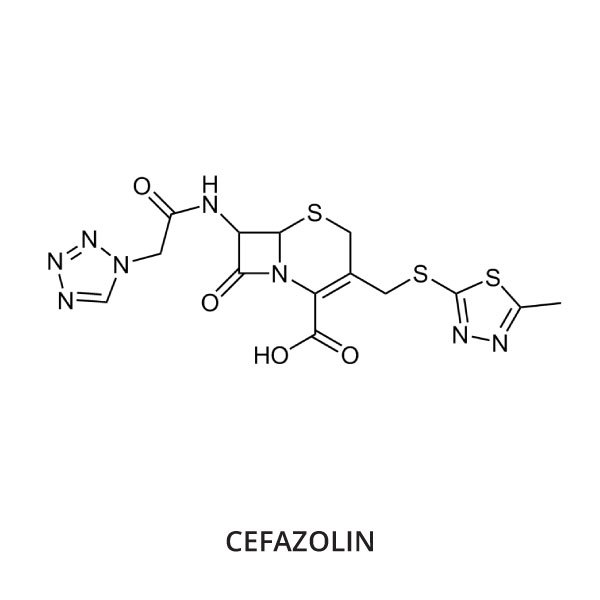
Cefazolin

Cefazolin (also known as cefazoline or cephazolin) is a semi-synthetic first-generation injectable cephalosporin. Cefazolin has broad-spectrum antibiotic action due to inhibition of bacterial cell wall synthesis. It is used for the treatment of a number of bacterial infections in poultry, especially against those caused by staphylococci and streptococci species of Gram positive bacteria.

Note: Cephalosporins may disturb the normal intestinal microflora of poultry, particularly when administered orally and at high doses.

Disclaimer: Use at your own risk. We assume no responsibility for the use of the drug, dosages given and for any misstatement, error, negligent, or otherwise.

  • 25-75 mg/kg IM, IV q12h (B Speer 2016)
  • Acetylsalicylic acid: The risk or severity of nephrotoxicity can be increased when Acetylsalicylic acid is combined with Cefazolin.
  • Acyclovir: Cefazolin may decrease the excretion rate of Acyclovir which could result in a higher serum level.
  • Allopurinol: Cefazolin may decrease the excretion rate of Allopurinol which could result in a higher serum level.
  • Amikacin: The risk or severity of nephrotoxicity can be increased when Amikacin is combined with Cefazolin.
  • Amoxicillin: Cefazolin may decrease the excretion rate of Amoxicillin which could result in a higher serum level.
  • Amphotericin B: The risk or severity of nephrotoxicity can be increased when Amphotericin B is combined with Cefazolin.
  • Ampicillin: Cefazolin may decrease the excretion rate of Ampicillin which could result in a higher serum level.
  • Bacitracin:The risk or severity of nephrotoxicity can be increased when Bacitracin is combined with Cefazolin.
  • Carbenicillin:The excretion of Cefazolin can be decreased when combined with Carbenicillin.
  • Carprofen:The risk or severity of nephrotoxicity can be increased when Carprofen is combined with Cefazolin.
  • Cefadroxil:Cefazolin may decrease the excretion rate of Cefadroxil which could result in a higher serum level.
  • Cefotaxime:The risk or severity of nephrotoxicity can be increased when Cefotaxime is combined with Cefazolin.
  • Chloramphenicol:The excretion of Cefazolin can be decreased when combined with Chloramphenicol.
  • Chloroquine:Cefazolin may decrease the excretion rate of Chloroquine which could result in a higher serum level.
  • Cimetidine:Cefazolin may decrease the excretion rate of Cimetidine which could result in a higher serum level.
  • Ciprofloxacin:Cefazolin may decrease the excretion rate of Ciprofloxacin which could result in a higher serum level.